
OnTime Mobile API integration and courier OpenData delivery solutions
Production-ready integration for OnTime Mobile order operations, proof-of-delivery records, and dispatch synchronization across your ERP, BI, and customer systems.
Turn field delivery activity from OnTime Mobile into reusable APIs and auditable business data
OnTime Mobile is not a simple local utility. It handles authenticated courier workflows with server-side state, order lifecycle updates, dispatch communication, location traces, barcode events, and offline-first synchronization. That combination makes it highly suitable for an OpenData integration strategy where operational records are normalized and pushed into your own systems for automation and reporting.
- Order and status timeline data is valuable for SLA analytics, billing reconciliation, and customer visibility dashboards.
- Photo, signature, and barcode proof events can be mapped into compliance evidence packages and dispute-resolution workflows.
- Driver availability and GPS streams support dynamic dispatch planning, subcontractor monitoring, and exception alerts.
Feature modules for OnTime Mobile data integration
Order lifecycle API module
Expose assigned, in-progress, picked-up, delivered, transferred, and exception statuses as normalized events. Typical use: reconcile courier activity against invoicing rules and customer promises by tracking every state transition with timestamp and actor fields.
Proof-of-delivery evidence module
Capture signature vectors, photo attachments, and related delivery notes with secure file metadata. Typical use: build a self-service claims portal where support teams retrieve signed evidence and image artifacts without manually opening the dispatch console.
Driver signal and availability module
Map availability toggles, expected availability changes, and assignment eligibility into your workforce service. Typical use: route high-priority orders to active contractors and suppress dispatch attempts to drivers who are temporarily unavailable.
Barcode and scan event module
Ingest barcode scans linked to order records and scan context. Typical use: warehouse-to-driver handoff validation, where each parcel scan updates a chain-of-custody log consumed by internal audit or customer reporting APIs.
GPS and route telemetry module
Store periodic location snapshots and map-routing milestones from the mobile workflow. Typical use: detect route deviations and late-arrival risk, then trigger webhook notifications to operations teams or downstream ETA engines.
Offline synchronization reconciliation module
Queue field actions locally and replay them when connectivity resumes, with idempotency keys to avoid duplicates. Typical use: support rural or indoor delivery environments while preserving accurate final records in ERP and BI systems.
OnTime Mobile screenshots
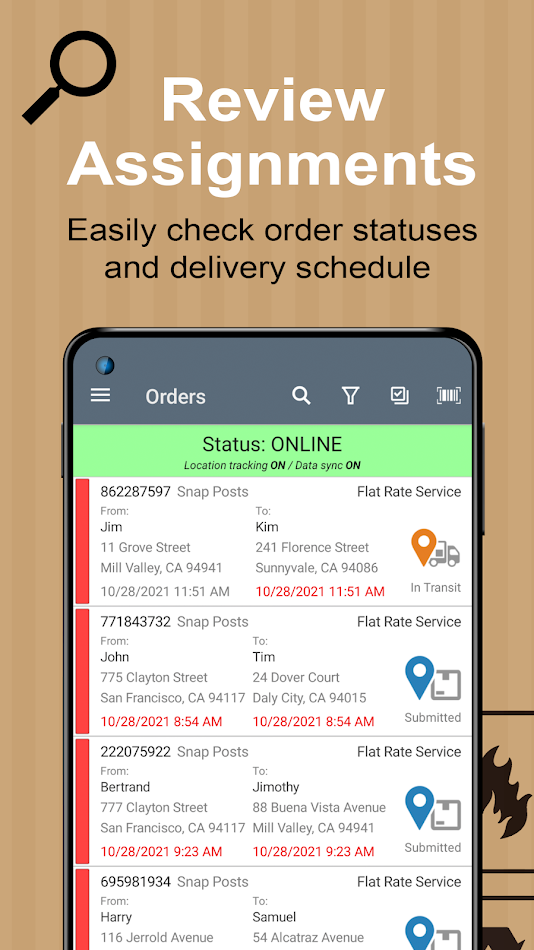
Every screenshot below is clickable. Select any image to open a larger preview and inspect order, dispatch, and driver workflow UI details without cluttering the default page view.



Data available for integration (OpenData perspective)
This inventory is based on published OnTime Mobile capabilities and OnTime 360 developer resources. It is structured to support teams building courier dispatch API integration, delivery order data export pipelines, and proof-of-delivery sync services.
| Data type | Source screen or feature | Granularity | Typical use |
|---|---|---|---|
| Assigned order list | Driver order queue, self-dispatch list | Per order, near real-time updates | Dispatch board synchronization, backlog monitoring, revenue forecasting |
| Order status history | Order edit and lifecycle actions | Event-level timestamps, user/device context | SLA compliance, billing reconciliation, operational audits |
| Proof artifacts | Photo attachment and signature capture | Per stop with file metadata | Claims handling, legal evidence, customer service verification |
| Driver availability signals | Signal availability controls | State changes with effective times | Workforce optimization, shift planning, contractor utilization analytics |
| GPS coordinates and route context | Location tracking and map routing | Interval-based pings and route milestones | ETA modeling, exception detection, geofencing alerts |
| Barcode scan linkage | Camera barcode scanner workflow | Scan-level record tied to order ID | Chain-of-custody integrity, warehouse handoff validation, compliance reporting |
| Offline sync queue events | Offline synchronization engine | Action-level replay records | Conflict resolution, idempotent import, resilient field operations |
Typical integration scenarios
Scenario 1: Last-mile SLA command center
Business context: national courier operators need unified visibility across regions. Data/API used: assigned orders, status transitions, and GPS points. OpenData mapping: normalized event streams feed a central analytics layer, powering late-risk dashboards and daily SLA exports for enterprise customers.
Scenario 2: Proof-of-delivery to invoice release
Business context: finance teams delay billing until delivery proof is confirmed. Data/API used: signature files, photo attachments, completed timestamps, and exception notes. OpenData mapping: an automated rule engine checks evidence completeness, then releases invoice generation in ERP with audit references.
Scenario 3: Contractor availability orchestration
Business context: mixed fleets of employees and independent contractors create dispatch friction. Data/API used: availability state, expected change time, and transfer/self-dispatch records. OpenData mapping: status data becomes a labor-supply feed for assignment algorithms and payout planning services.
Scenario 4: Barcode-first warehouse handoff
Business context: high-volume hubs require scan-based parcel control. Data/API used: barcode scans, order matches, pickup confirmation actions, and timestamped user identities. OpenData mapping: item movement records are published into traceability APIs consumed by operations, support, and customer portals.
Scenario 5: Offline-first continuity and reconciliation
Business context: deliveries continue in low-connectivity zones. Data/API used: queued offline actions and replay outcomes on reconnect. OpenData mapping: reconciliation jobs compare replayed actions with server records, prevent duplicates, and emit correction events to downstream BI and compliance stores.
Technical implementation: API and protocol delivery scope
Snippet A: auth and token exchange (pseudocode)
POST /v1/ontime/auth/session
Content-Type: application/json

{
  "tenant_id": "acme-courier",
  "username": "dispatcher@acme.com",
  "password": "********",
  "api_key_alias": "ops-integration-key"
}

200 OK
{
  "access_token": "eyJhbGciOi...",
  "expires_in": 3600,
  "scope": ["orders:read","orders:write","proof:read"]
}
Snippet B: order timeline query (pseudocode)
GET /v1/ontime/orders/{order_id}/timeline?from=2026-01-01&to=2026-01-31
Authorization: Bearer <ACCESS_TOKEN>

200 OK
{
  "order_id":"ORD-90211",
  "events":[
    {"type":"assigned","ts":"2026-01-07T08:14:11Z","driver_id":"DRV-44"},
    {"type":"pickup_confirmed","ts":"2026-01-07T09:02:19Z"},
    {"type":"delivered","ts":"2026-01-07T11:48:02Z","pod_signature_id":"SIG-733"}
  ]
}
Snippet C: proof webhook and retry handling
POST /v1/webhooks/proof-delivery
{
  "event_id":"evt_18920",
  "order_id":"ORD-90211",
  "proof":{
    "signature_url":"https://cdn.example/sig/SIG-733.png",
    "photo_urls":["https://cdn.example/pod/P-1.jpg"]
  }
}

// Receiver rule:
// - Verify HMAC signature
// - Upsert by event_id for idempotency
// - Return 202 and process asynchronously
// - Retry with exponential backoff on 5xx
Deliverables checklist
- Protocol analysis report for login/session flow, permission scope, and attachment handling.
- Runnable source code for auth, order, proof, and driver-status endpoints (Go, Python, or Node.js by request).
- OpenAPI specification, Postman collection, and environment templates for staging/production rollout.
- Automated test scripts for success paths, token expiry, timeout retries, and replay conflict cases.
- Integration documentation covering field mappings, retention rules, and operational runbooks.
Compliance and privacy
OnTime Mobile and OnTime 360 are used across multiple regions, so integration governance should follow a cross-jurisdiction baseline. For teams serving EU clients, GDPR principles (data minimization, lawful basis, retention control, and subject-access readiness) should be enforced for delivery contact data, signatures, and geolocation traces. For US operations, state privacy frameworks such as CCPA/CPRA are relevant when courier records contain personal identifiers. Our implementation model is authorization-first: we only process approved account access, provide auditable logs, and support scoped credentials to limit exposure by customer or business unit.
Security-wise, published OnTime resources describe API security key usage and configurable permission scope. In practical integration design, this maps to least-privilege access, secret rotation schedules, and endpoint-level monitoring. We also include transport encryption requirements, attachment access control policies, and webhook signature validation to reduce replay or tampering risks in high-volume delivery environments.
Data flow and architecture
- Node 1: OnTime Mobile client generates order, scan, proof, and location events.
- Node 2: Integration ingestion API authenticates and normalizes payloads from authorized sessions.
- Node 3: Operational storage keeps event history, attachment references, and reconciliation state.
- Node 4: Outputs feed dashboards, ERP sync jobs, customer portals, or partner APIs.
This four-node pipeline follows an OpenData pattern: collect, standardize, govern, and distribute. The same structure supports both source-code handoff and pay-per-call hosted APIs, so teams can start with managed endpoints and later migrate to self-hosted implementation when internal platform maturity increases.
Market positioning and user profile
OnTime Mobile is positioned as a field execution layer inside the broader OnTime 360 courier dispatch stack, primarily serving B2B courier companies, local delivery operators, and dispatch-led fleets rather than direct consumer logistics. The core user profile includes dispatchers, owner-operators, and drivers who need real-time assignment handling, proof capture, and routing support on Android and iOS devices. Platform focus is operational reliability in mixed connectivity conditions, and recent OnTime Version 7 era updates plus 2026 release-note activity indicate continued investment in mature, production-facing workflows for delivery businesses.
Similar apps and integration landscape
- Onfleet: Stores route, ETA, and proof-of-delivery records; teams often request unified delivery KPI exports across Onfleet and OnTime environments.
- Bringg: Focuses on delivery orchestration and carrier management; integration programs commonly normalize multi-carrier status events into one reporting model.
- Tookan: Handles task dispatch, driver tracking, and customer notifications; companies migrating between systems need cross-platform order history mapping.
- Track-POD: Emphasizes proof-of-delivery evidence and route execution; its data model aligns closely with signature/photo reconciliation use cases.
- DispatchTrack: Captures dispatch plans and execution telemetry; shared enterprise users often ask for consolidated route compliance analytics.
- Route4Me: Provides route optimization datasets that can be combined with OnTime execution events for cost and punctuality analysis.
- Routific: Supports route planning and driver run schedules; businesses connect planned-vs-actual delivery timelines across both stacks.
- Elite EXTRA: Covers last-mile scheduling and dispatch operations; integration demand often centers on common invoice and POD export schemas.
- LogiNext Mile: Tracks fleet and delivery milestones; organizations with regional tool diversity use shared APIs to standardize milestone definitions.
About our studio
We are a technical service studio focused on app interface integration and authorized API integration for operations-heavy businesses, including mobility, logistics, and fintech-adjacent services. Our team combines mobile engineering, protocol analysis, backend architecture, and data-compliance implementation experience, so clients receive practical integration assets rather than generic consulting slides.
For OnTime Mobile projects, we can deliver a complete path from requirement breakdown to production-ready API output: reverse engineering and protocol analysis when needed, data-field mapping, endpoint implementation, test harnesses, and documentation packages that development and operations teams can use immediately. We support Android and iOS integration contexts and can align outputs to your existing cloud stack.
- Model 1: runnable source code and docs from $300, pay after delivery satisfaction.
- Model 2: pay-per-call hosted APIs when you prefer usage-based integration economics.
- Coverage: order integration, statement-like activity exports, dispatch synchronization, and proof pipelines.
Contact information
Share your target app, required data modules, expected daily volume, and preferred delivery model. We will respond with a scoped implementation plan, timeline estimate, and technical assumptions list.
Workflow
- Requirement intake: confirm flows such as courier dispatch API integration, proof-of-delivery sync, and delivery order data export.
- Protocol and schema mapping: define auth method, entities, and event consistency rules.
- Implementation sprint: build endpoints, webhook handlers, and reconciliation jobs.
- Validation: execute integration tests for normal, offline replay, and failure scenarios.
- Handover: deliver source code, API docs, test plans, and deployment notes.
FAQ
What do you need from us first?
Target app name, business goals, required data entities, and preferred timeline are enough for an initial design.
Can you support both internal and external API consumers?
Yes. We commonly produce internal operations APIs and partner-facing APIs from the same normalized data layer.
How do you reduce integration risk?
We include idempotency keys, retry logic, structured error models, and field-level mapping documentation before go-live.
Original app introduction (collapsed by default)
OnTime Mobile is designed for couriers who process assigned orders in the field and stay connected with dispatch through a subscription-based OnTime 360 environment. The app includes signal availability updates, photo attachments, signature capture, order edits, self-dispatch actions, GPS tracking, barcode scanning, and map routing support. It is built for real delivery operations where field workers need fast updates and centralized visibility.
A key operational characteristic is offline synchronization: drivers can continue working without stable internet, and the app synchronizes completed actions once connectivity returns. This architecture is highly relevant for integration because it produces structured event streams that can be replayed and reconciled. Secure encrypted data transmission is explicitly part of the product positioning, which aligns with enterprise-grade integration and compliance expectations.
Combined with documented developer resources around OnTime APIs, this creates a practical foundation for organizations that need OpenData-ready courier operations: consistent order-state data, auditable proof records, and reusable interfaces for analytics, customer communication, and back-office automation.